
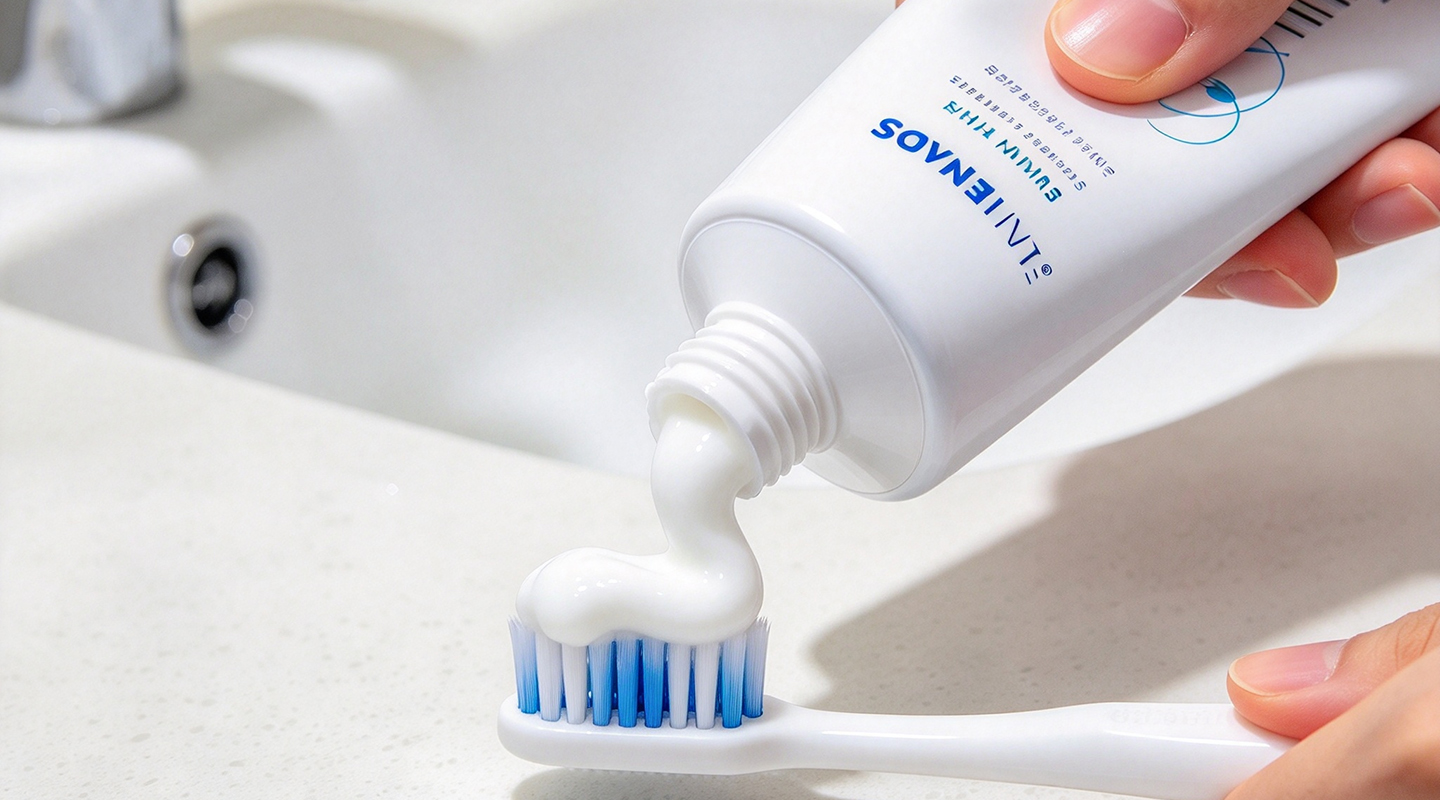
Toothpaste separation and thinning are the most visible quality complaints. Whether it holds shape when squeezed, whether it separates after sitting, whether it thins in heat — all depend on whether CMC’s degree of substitution (DS) matches its gel temperature.
How CMC Thickens Toothpaste
CMC is an anionic cellulose ether. It thickens by chain extension and entanglement in water. DS is the average number of hydroxyl groups per glucose unit replaced by carboxymethyl groups, typically 0.6–1.5. Higher DS means stronger hydrophilicity but lower gel temperature.
Three Ways DS Affects Performance
Thickening efficiency
Higher DS improves solubility and thickening. But above DS 1.2, charge density becomes excessive. Electrostatic repulsion contracts the chain, and efficiency drops.
Water retention
High-DS CMC has strong hydrophilicity and good water retention, helping prevent separation. But it is more salt-sensitive and may lose viscosity in fluoride or high-salt formulas.
Gel temperature
This is the most overlooked variable. CMC gel temperature decreases as DS rises. Low DS (0.6–0.8) has a high gel temperature and holds viscosity well in heat. High DS (0.9–1.2) has a low gel temperature and phase-separates at high heat, causing thinning and separation.
Matching Experiment and Results
Fix the base toothpaste formula, vary only CMC DS, and test viscosity retention and separation at 25°C, 40°C, and 50°C.
DS 0.7
High gel temperature, good viscosity at 50°C. But thickening and water retention are weaker, requiring higher dosage. Best for high-temperature environments.
DS 0.9
Good balance of thickening and water retention. Ideal at 40°C, slight thinning at 50°C. Best for regular toothpaste stored at room temperature.
DS 1.1
Highest thickening efficiency, best room-temperature water retention. But lowest gel temperature. Viscosity drops at 40°C, severe separation at 50°C. Not suitable for heat or long-distance transport.
Selection Strategy
High heat or long transport: choose low DS (0.6–0.8). Blend with xanthan gum to offset weaker thickening.
Regular room-temperature toothpaste: medium DS (0.8–1.0) offers the best cost-performance.
High-humidity, clear formulas: high DS (1.0–1.2), but control temperature strictly and blend a salt-tolerant thickener.
Blending approach: combine CMC with xanthan gum or HEC to balance thickening, water retention, and heat resistance.
Practical Tips
CMC dosage is recommended at 0.5%–1.5%. High-temperature environments favor low DS; room-temperature environments favor medium DS. After adjustment, run accelerated aging tests: 4 weeks at 40°C, 2 weeks at 50°C. Monitor separation and viscosity changes. Only when targets are met is the formula reliable.
Conclusion
Toothpaste separation and thinning come down to a mismatch between CMC degree of substitution and gel temperature. Understand your storage conditions and formula system to select the right CMC and keep the paste stable.





Leave A Comment